
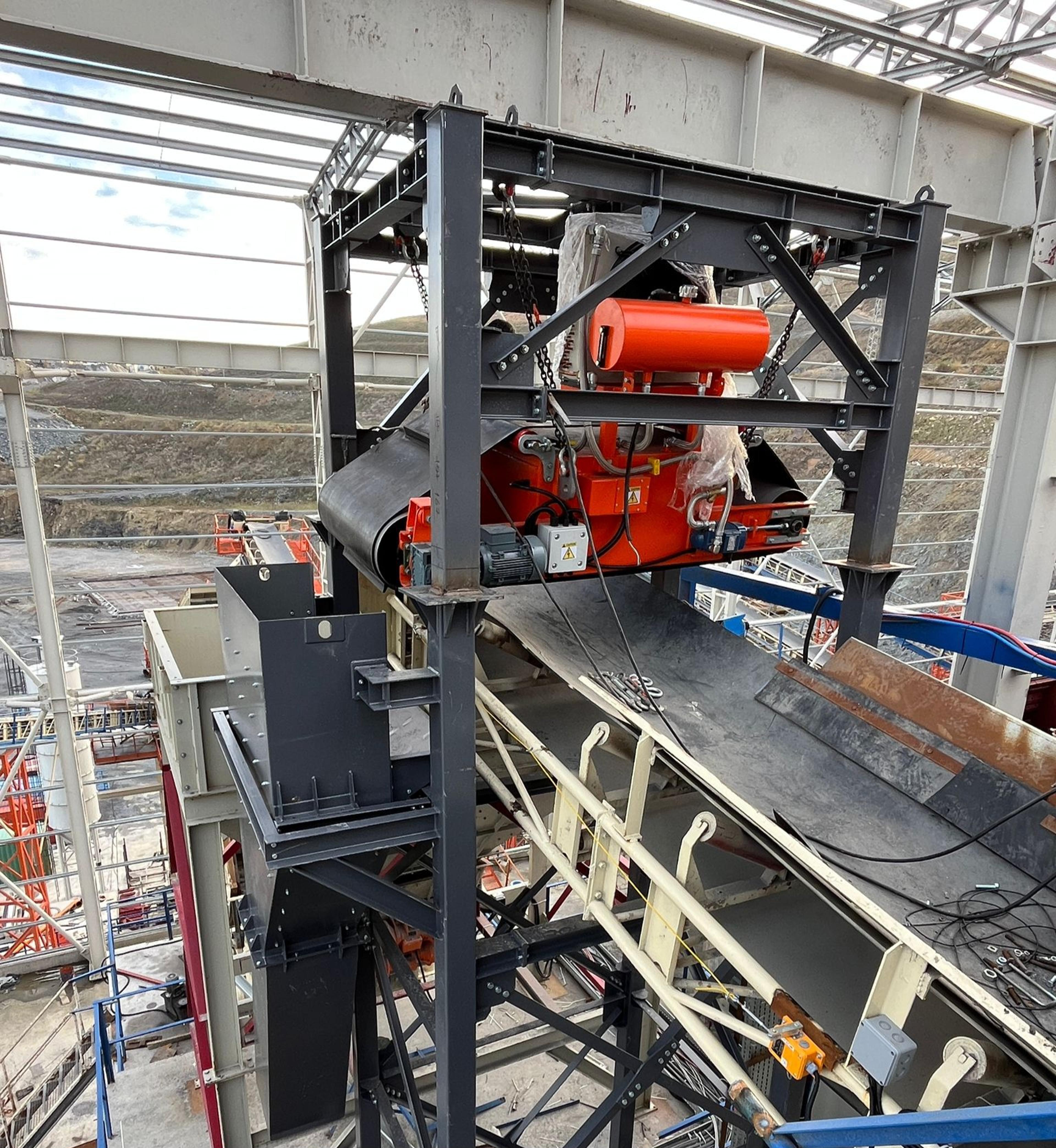
Magnetic Separator Buying Guide: How to Choose the Right One for Your Application
A practical decision framework for selecting drum, overband, WHIMS, roll, and high-gradient magnetic separators based on ore or recycling feed properties.
Choosing a magnetic separator means matching three things at once: the magnetic susceptibility of the target mineral or contaminant, the particle size and moisture of the feed, and the production goal — concentrate, scalp, or scavenger. This buying guide walks through the decision points BAS engineers ask before specifying a unit, so your shortlist is short and your pilot tests focus on what matters.
Step 1: Define the separation objective
Magnetic separation does not have one job. The same field strength can be wrong for one objective and exactly right for another:
- Concentration / upgrading — recover a magnetic mineral as a salable concentrate (e.g. magnetite at 65%+ Fe). Drives field strength, multi-stage layout, and water management.
- Tramp removal / scalping — protect crushers, mills, and ECS rotors from stray ferrous. Drives belt coverage, magnet reach across burden, and reliable discharge of captured tramp.
- Purification — remove iron-bearing impurities from non-metallic ores (silica, kaolin, feldspar, carbonates). Drives high-gradient and wet high-intensity routes.
- Scavenging — recover residual magnetic mineral from tailings to lift overall plant recovery; lower grade target, high throughput.
Step 2: Map susceptibility to separator family
Match the magnetic susceptibility of the target with the appropriate field intensity range:
- Ferromagnetic (strong) — magnetite, iron, low-alloy steels. Use drum, pulley, and overband magnets at 0.05–0.3 T. Wet drum LIMS for slurry-fed magnetite.
- Paramagnetic (weak to medium) — hematite, ilmenite, chromite, manganese, biotite, garnet, monazite. Use **WHIMS, high-intensity wet electromagnetic separators, and rare-earth roll separators** at 0.6–2.0 T.
- Diamagnetic (very weak, repelled) — quartz, calcite, feldspar. Magnetic separation is used to remove iron-stained impurities, not to recover the host. WHIMS or high-gradient roll at 1.5+ T removes color-bearing iron grains.
- Non-magnetic conductors — aluminum, copper, brass. Outside magnetic separation entirely; use eddy current separators.
Step 3: Choose dry or wet processing
Process route is often dictated by upstream and downstream operations as much as by separation physics:
- Dry processing wins when the ore is naturally dry, water is scarce, downstream is thermal (kiln, smelter), or the product must be sold dry. Best fit: dry magnetic drums, overband magnets, vertical roll separators.
- Wet processing wins when fines must be dispersed, dust must be controlled, the feed is already a slurry from grinding, or selectivity demands water rinsing on a matrix. Best fit: wet magnetic drums, WHIMS, high-intensity wet electromagnetic filters.
- Hybrid plant — many real circuits dry-strip magnetite first then wet-WHIMS the fines. Plan the water balance during selection, not after commissioning.
Step 4: Particle size and burden depth
Burden depth — the thickness of material above the magnet — determines whether the magnetic field actually reaches the deepest particles. A 300 mm burden under a magnet specified for 200 mm reach will leak iron continuously. Map your separator to the real plant condition:
- Coarse, deep burden (>250 mm) — high-intensity overband magnet with extended reach, hung close to the belt; or stationary plate magnet with narrow chute.
- Medium burden (100–250 mm), heavy throughput — drum magnet (preferred over plates because tramp self-discharges).
- Fine burden (<50 mm) — pulley magnet or roll separator works; for selectivity at very fine sizes, wet routes outperform.
- Slurry feeds — wet drum or WHIMS, sized by m³/h not by tonnes/h on the belt.
Step 5: Capacity and gap tuning
Throughput at the magnet is specific tonnes per hour per metre of magnet width, not the gross plant tonnage. Overload any separator and:
- magnetic loading saturates and weakly magnetic particles bypass capture,
- belt speed forces deeper burden and the bottom layer never enters the field,
- self-discharge fails and tramp falls back into the product on the next rotation.
Adjusting the air gap between magnet and belt adds reach but lowers field intensity at the particle. The right gap is the smallest one that still allows the largest expected piece to pass without contact.
Step 6: Cost-of-ownership levers
Selection is not only capex. The biggest field surprises happen on operating cost:
- Permanent vs electromagnetic — permanents need no power but lose flux on aging and impact; electromagnetics consume power but allow purge cycles.
- Belt life — eccentric rotors and proper ferrous removal upstream multiply belt MTBF by 2–3×.
- Maintenance access — pick a frame design that lets one technician swap a belt in a shift, not three days.
- Power and water — wet routes can dominate energy bills; estimate kWh per tonne of concentrate when comparing.
- Spares and warranty — local stock and Turkish-built parts mean shorter downtime; ask vendors for MTTR commitments.
Decision tree (cheat sheet)
- Ferrous and you only want to remove tramp? → Overband or pulley magnet.
- Magnetite-rich ore, coarse and dry? → Dry drum LIMS (low-intensity).
- Magnetite-rich ore, ground to fines? → Wet drum LIMS in the grinding circuit.
- Hematite/ilmenite/chromite paramagnetic fines? → WHIMS or high-intensity wet electromagnetic separator.
- Industrial mineral (silica/kaolin) with iron-stain? → Rare-earth roll dry, or WHIMS wet.
- Aluminum and copper from shredded scrap? → Magnet first, then eddy current separator.
Why pilot testing is mandatory
Catalog curves are useful for short-listing; only bench and pilot tests on a representative sample validate the full recovery–grade trade-off. BAS operates a solution center for sample prep, sieve and density analysis, magnetic susceptibility measurement, and small-batch separation trials before any plant-scale order is placed.
Where BAS fits
BAS supplies the full magnetic separation portfolio — overband, drum, WHIMS, roll, and high-gradient — together with ore beneficiation plant integration, scrap separation lines, and lifetime engineering support. Use the separator selection wizard to narrow models in minutes.
Frequently Asked Questions
What is the difference between a magnetic separator and an eddy current separator?
A magnetic separator extracts ferromagnetic and paramagnetic materials using a static or rotating magnetic field. An eddy current separator extracts non-magnetic but conductive metals (aluminum, copper, brass) by inducing eddy currents that produce a repulsive force. They are complementary — most plants use both in sequence.
How strong does the magnet need to be?
It depends on susceptibility. Ferromagnetic minerals respond at 0.05–0.3 T (low-intensity). Paramagnetic minerals require 0.6–2.0 T (high-intensity wet or rare-earth roll). Iron-stain on industrial minerals usually needs 1.5–2.0 T because the iron content is low and well-disseminated.
Should I use dry or wet magnetic separation?
Wet processing is better for fines, dust-prone feeds, slurry circuits, and weakly magnetic minerals that need dispersion. Dry processing wins when water is scarce, the feed is naturally dry, the downstream step is thermal, or the product must remain dry. Many plants use both in series.
Can a magnetic separator remove rust?
Yes — rust (iron oxide) is magnetic enough to be captured by overband or roll magnets at moderate field. Magnetic separators are used in food, plastics, glass, and grain industries specifically to remove rust flakes and ferrous tramp.
How long do magnetic separators last?
Permanent magnetic separators with sealed neodymium blocks easily run 15–20 years with consumable belt and bearing replacement. Electromagnetics depend on coil insulation life — typically 10–15 years before rewind, depending on duty cycle and ambient temperature.