
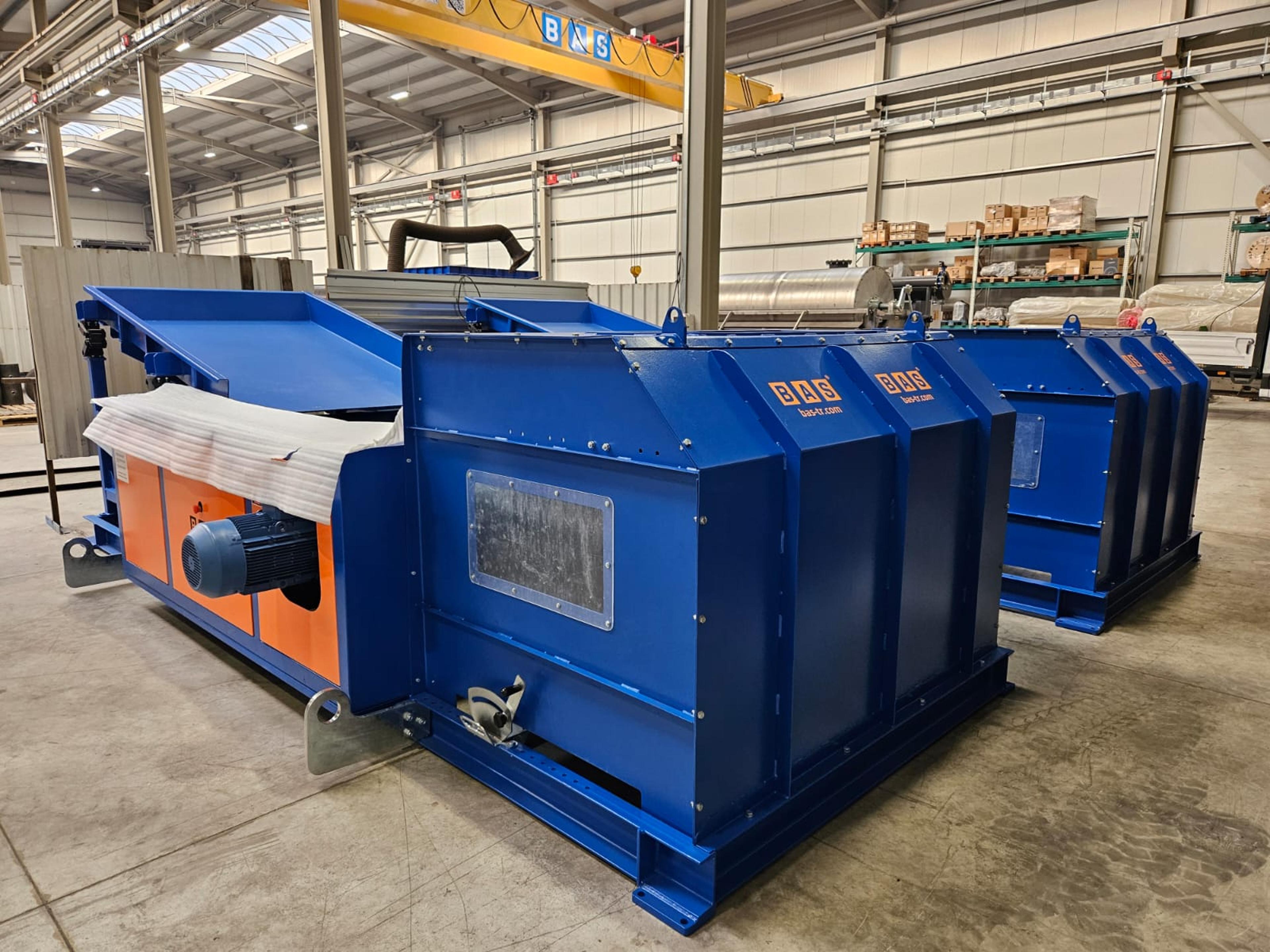
What is an Eddy Current Separator? Complete Guide for Recyclers and Mineral Processors
How eddy current separators recover non-ferrous metals: induction physics, rotor types, particle size limits, real applications, and where BAS ECS systems fit in plants.
An eddy current separator (ECS) is an electromechanical machine that uses a fast-rotating magnetic rotor to induce circulating electric currents inside conductive non-ferrous particles. Those induced currents create a repulsive force that throws conductive metals — aluminum, copper, brass, zinc — farther on the conveyor trajectory than non-conductive materials, enabling automatic sorting at industrial throughput. ECS units are the standard tool for recovering non-ferrous metals from shredded scrap, incinerator bottom ash, glass cullet, PET flake, and post-shredder e-waste streams.
How an eddy current separator works
When a non-ferrous, conductive particle enters the alternating magnetic field at the rotor head, Faraday's law of induction generates eddy currents inside the metal. By Lenz's law these currents produce a secondary magnetic field that opposes the rotor field; the resulting Lorentz force has a component that lifts and accelerates the particle away from the rotor, while inert (non-conductive) materials drop in a near-vertical trajectory. Engineers call the steel splitter at the end of the belt the trajectory cut point — moving it by a few millimeters changes which particles report to the metal product.
The physical effect scales with the conductivity-to-density ratio (σ/ρ): aluminum (~37 MS/m, 2.7 g/cm³) launches very strongly, copper (~58 MS/m, 8.9 g/cm³) launches strongly but lands closer than aluminum, brass and zinc launch moderately, and stainless steel (low conductivity, magnetic) barely responds to ECS — it must be removed by a downstream stainless-steel separator instead.
Rotor configurations: concentric vs eccentric
Two rotor families dominate the market and the choice has direct cost and performance impact:
- Concentric rotor — magnets cover the full circumference. Lower cost and easier to service, but ferrous fines magnetically attached to the belt cause heating and sticking. Best where ferrous removal upstream is excellent.
- Eccentric (offset) rotor — magnets clustered on the discharge arc only. The metal-free arc lets ferrous tramp drop off cleanly, dramatically extending belt life and improving non-ferrous purity. Standard for shredder residue and IBA processing.
- Pole frequency — higher pole counts (22-pole, 38-pole) increase the ω·B² term and recover finer aluminum (0.5–3 mm flake) at the cost of belt speed and throughput. Coarse aluminum cans/profile work fine on lower pole counts at higher TPH.
Typical particle size limits
ECS performance is bounded above and below by physics, not just by mechanical envelope:
- Below 1 mm — aerodynamic drag dominates over induction force; particles bounce on the belt and trajectory becomes random. Very high pole counts and tight feed control help, but recovery falls below 60% in most plants.
- 1–5 mm — sweet spot for fine ECS rotors; aluminum flake and copper wire fragments recover at 85–95% with good liberation.
- 5–50 mm — sweet spot for standard ECS; aluminum cans, profile, copper turnings recover at 90–98% with proper feed presentation.
- Above 80 mm — bulky pieces may not receive uniform induction; they often pre-sort by hand or by sensor before ECS to avoid blinding the splitter.
- Liberation matters more than peak field — composite packages (insulated wire, automotive harnesses) must be opened by shredding before ECS produces clean metal.
Where eddy current separators are used
Eddy current technology spans recycling and mineral processing. Common BAS-served applications include:
- Aluminum can and UBC recovery in MRFs and dedicated UBC lines, typically downstream of overband magnets and ballistic separators.
- Automotive shredder residue (ASR) — recovering Zorba (mixed non-ferrous) before sensor-based separation into Twitch (aluminum-rich) and Zurik (copper-rich).
- Incinerator bottom ash (IBA) — non-ferrous fines and coarse fractions account for 1–3% of IBA mass but 50%+ of its economic value.
- WEEE / e-waste — recovery of copper from PCB shredder fines after magnetic and air-knife pre-sorting.
- Glass cullet cleaning — removing aluminum closures before re-melt to prevent furnace damage.
- PET flake polishing — removing aluminum foil residues that survive the bottle wash line.
- Mineral beneficiation — separating native copper, silver-bearing fractions from milled feeds in some specialty operations.
ECS vs other separation technologies
ECS is rarely used alone. A typical recycling line stages technologies based on the target metal and feed condition:
- Magnetic separation first — overband magnets and drum separators strip ferrous to protect the ECS rotor and prevent false trajectories. See BAS overband magnetic separators for the upstream stage.
- ECS in the middle — recovers Zorba and clean aluminum-rich product as the main money-maker. Browse the BAS ECS lineup for rotor options.
- Sensor sorting after ECS — XRT, induction, and color systems split Zorba into traded fractions. ECS prepares the feed by removing inerts that would saturate sensor lines.
- Stainless steel separators at the tails — recovers austenitic stainless that ECS cannot launch.
Capital and operating cost cues
For a 5-tonnes-per-hour shredder line in 2026 the comparative numbers we see in tenders:
- Concentric rotor ECS, 1.0–1.5 m belt — entry tier, often used on light commercial recyclers and packaging streams.
- Eccentric rotor ECS, 1.5 m belt, NdFeB magnets — typical scrapyard tier; longer belt life, better Zorba purity. ROI commonly under 18 months at current Zorba prices.
- High-frequency (38-pole) ECS for fines — adds capex but unlocks under-5-mm aluminum that bypasses standard rotors.
Operating cost is dominated by belt wear (replace every 4,000–8,000 hours depending on feed), the small drive motor (5–22 kW typical), and labor for chute maintenance.
Sizing checklist before you buy
- Sample the feed — at least 100 kg representative for sieve, density, magnetic, and conductivity tests; trial in a vendor lab.
- Quantify ferrous remnants — every 1% ferrous reaching the ECS belt halves the rotor MTBF; size your magnets accordingly.
- Check moisture and stickiness — wet or oily feeds form bridges; you may need a vibratory dispersion stage.
- Confirm splitter geometry envelope — single splitter for clean cans; double splitter for mixed Zorba; triple for premium recyclers.
- Plan downstream handling — underestimating Zorba/Zurik logistics is the most common mistake; integrate bunkers and big-bag stations on day one.
Where BAS fits
BAS designs and manufactures ECS rotors, frames, and integrated lines for European and global recyclers, with a focus on robust eccentric rotor systems, ferrous-tolerant belt selection, and fast service support. Browse BAS ECS systems, pair them with overband magnets and an automated metal separator line, or use the separator selection wizard to get a sized recommendation.
Frequently Asked Questions
What does an eddy current separator separate?
An ECS separates conductive non-ferrous metals — primarily aluminum, copper, brass, and zinc — from a stream of inert materials such as plastics, glass, wood, and minerals. It does not separate ferrous metals (those need a magnetic separator) and it does not effectively separate stainless steel (which needs a dedicated stainless-steel separator).
How does an eddy current separator generate force on metals?
The rotating magnetic rotor produces a fast-changing magnetic field. By Faraday's law, this induces circulating electric currents — eddy currents — inside any conductive particle that passes nearby. By Lenz's law, those currents create a magnetic field that opposes the rotor field, and the interaction repels the particle. Higher conductivity means stronger eddy currents, which means a longer trajectory.
What particle size can an ECS handle?
Standard ECS rotors handle 5–50 mm well. Fine-eddy rotors (high pole count, smaller diameter) extend the lower limit to about 1–3 mm. Below 1 mm, aerodynamic drag dominates and recovery drops sharply. Above 80–100 mm, manual or sensor pre-sort is usually required.
Can an eddy current separator process wet feed?
Wet feeds reduce performance because moisture binds fines and clogs the splitter. Mild dampness is acceptable on coarse feeds; sticky or oily feeds need air-knife or vibratory dispersion upstream.
Does an ECS recover stainless steel?
No. Most stainless steel grades have low electrical conductivity and slight magnetic susceptibility, so ECS launch distance is too short to separate them reliably. A dedicated stainless-steel separator placed after the ECS recovers austenitic stainless.