
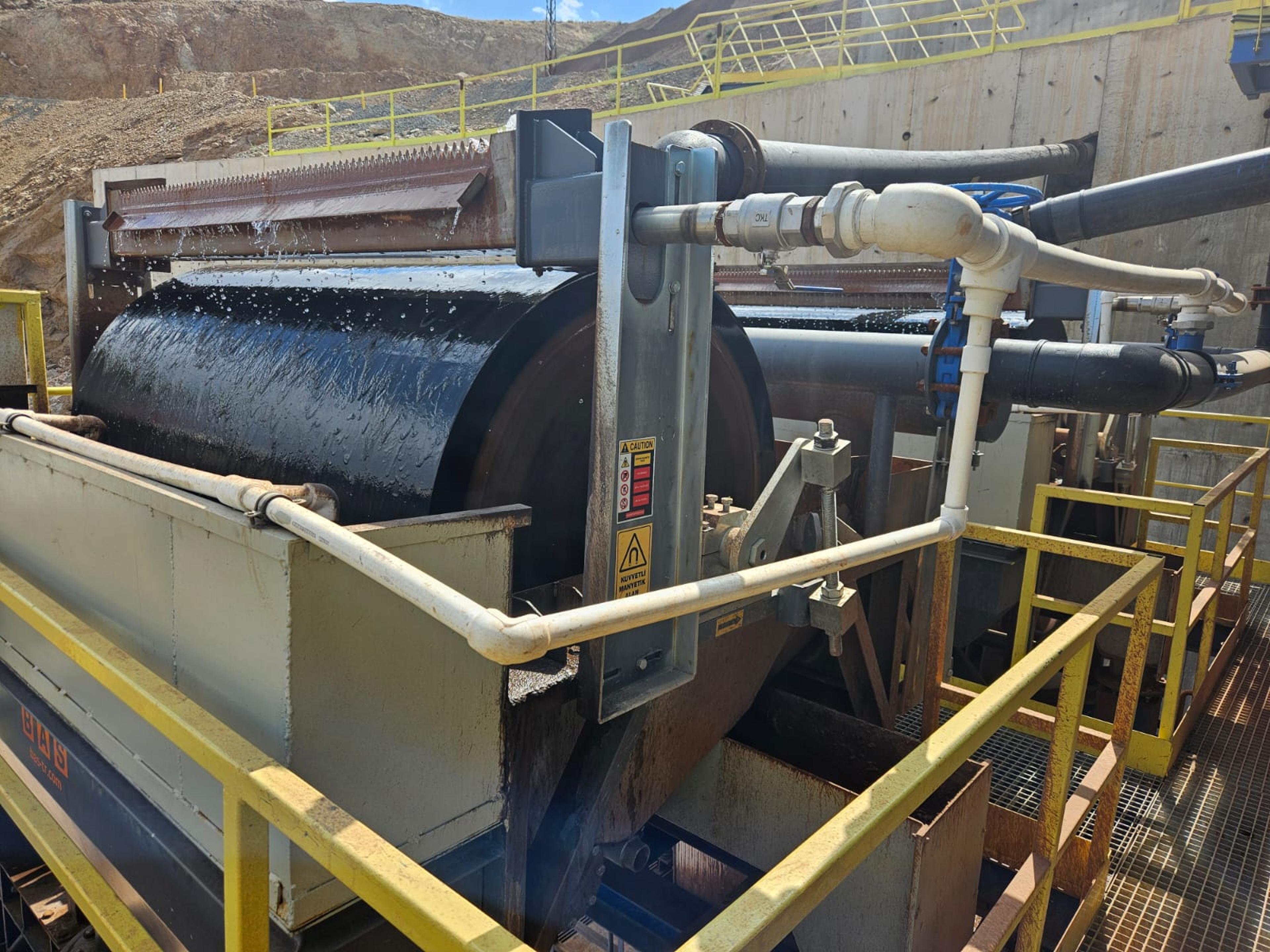
WHIMS vs Dry Drum Magnetic Separators: Which One Do You Need?
Compare wet high-intensity magnetic separation (WHIMS) and dry drum circuits across field strength, moisture tolerance, particle size, operating cost, and typical plant slots.
Wet high-intensity magnetic separators (WHIMS) and dry drum magnetic separators sit at opposite ends of the magnetic separation map — different physics, different feed envelopes, different plant slots. This guide is the head-to-head decision framework BAS engineers use when a customer asks "which one do I need?"
Quick comparison table
Read the bullets as a side-by-side: dry drum first, then WHIMS for the same dimension.
- Field intensity — dry drum: 0.1–0.3 T (LIMS) or 0.5–0.8 T (medium-intensity). WHIMS: 0.8–2.0 T.
- Target susceptibility — dry drum: ferromagnetic (magnetite, low-alloy steel). WHIMS: paramagnetic (hematite, ilmenite, chromite, garnet) and weakly magnetic minerals.
- Particle size — dry drum: 0.5–50 mm typical. WHIMS: 0.05–2 mm typical (slurry-fed, ground feed).
- Moisture — dry drum: <3% surface moisture; clay-rich feeds peg the drum. WHIMS: feed must be a slurry (typically 20–35% solids).
- Capacity — dry drum: 50–500 t/h per metre of drum width. WHIMS: 5–80 t/h per machine depending on matrix and gap.
- Capex — dry drum: lower per ton of capacity. WHIMS: higher (matrix, water handling, control system).
- Opex driver — dry drum: belt and bearings. WHIMS: matrix wear, water/pumping, power for electromagnet coils.
- Typical plant role — dry drum: bulk magnetite recovery, tramp removal, recycling pre-sort. WHIMS: weakly magnetic concentration, industrial mineral purification.
When dry drum wins
Dry drum magnetic separators dominate plants where the ore is naturally dry, water is scarce, or the product moves to a thermal step downstream:
- Magnetite mining and beneficiation — DSO and concentrate plants use dry drum LIMS at the head end before any wet step.
- Steel slag and EAF dust processing — coarse magnetic recovery before milling for fine WHIMS or air-tabling.
- Aluminum and metal recycling — dry drums strip ferrous from shredded scrap before eddy current separation.
- Bulk material handling protection — drum magnets at conveyor heads remove tramp metal that would damage downstream equipment.
- Industrial minerals at coarse size — silica sand and feldspar pre-sort; only the finer cuts continue to WHIMS.
Browse the BAS dry magnetic drum separator portfolio and overband magnetic separators for the dry-route stages.
When WHIMS wins
WHIMS systems shine when the value is locked in fines that respond only to high-intensity fields and need water dispersion to behave properly:
- Hematite ore concentration — paramagnetic recovery from ground feed at 1.0–1.5 T is the primary driver in BIF (banded iron formation) plants worldwide.
- Ilmenite and chromite circuits — selective recovery of titanium- and chromium-bearing minerals from heavy mineral sands and primary chromite ores.
- Manganese ore upgrading — paramagnetic Mn-bearing minerals (pyrolusite, psilomelane) recover at 0.8–1.2 T.
- Industrial mineral purification — kaolin, silica sand, and feldspar have very low iron acceptance criteria for glass and ceramics; WHIMS removes paramagnetic iron-stain at 1.5+ T.
- Rare earth and lithium pre-concentration — many REE-bearing minerals are paramagnetic; WHIMS provides a low-cost upstream concentration step.
BAS supplies high-intensity wet electromagnetic separators and high-intensity wet electromagnetic filters tuned for these duties.
Hybrid layouts that work
In real plants, dry drum and WHIMS are often complementary, not alternatives. A typical magnetite-hematite mixed BIF plant runs:
- Crushing and dry screening at the mine head.
- Dry drum LIMS recovers coarse magnetite and rejects gangue at –50 mm.
- Ball mill grinds the LIMS reject to liberate hematite (~80% passing 75 µm).
- WHIMS at 1.0–1.5 T concentrates hematite from the ground stream.
- Combined LIMS concentrate and WHIMS concentrate go to thickening and pelletizing.
Skipping the dry stage costs grinding energy on material that magnetite drum could have rejected for free; skipping WHIMS leaves hematite in tailings forever.
Where to lab-test before buying
BAS solution center runs Davis Tube tests for magnetite susceptibility, lab-scale WHIMS for paramagnetic feeds, and pilot-scale dry drum benchmarks. Walk-in samples typically receive a written test report within a week, with grade–recovery curves and equipment recommendation.
Cost benchmarking
For an iron ore project producing 1 Mt/y of concentrate, a dry drum LIMS train at the head end usually represents 5–10% of the magnetic separation capex but rejects 20–40% of the run-of-mine mass — a heavy energy save downstream. WHIMS adds 60–80% of magnetic separation capex but unlocks the hematite that LIMS leaves behind. The ROI math therefore depends on the mineralogy, not on the equipment alone.
Frequently Asked Questions
Is WHIMS better than a dry drum magnetic separator?
Neither is "better" in isolation — they target different minerals. Dry drum LIMS is the right tool for ferromagnetic minerals (magnetite). WHIMS is the right tool for paramagnetic minerals (hematite, ilmenite, chromite). Many plants need both in series.
What does WHIMS stand for?
WHIMS stands for Wet High-Intensity Magnetic Separator. The "wet" indicates slurry feed, and "high-intensity" refers to fields above 1 T, achieved with electromagnet coils and matrix elements.
Can WHIMS process dry feed?
No. WHIMS requires water dispersion to disaggregate fines and rinse non-magnetic particles through the matrix. Dry feeds at high field clog the matrix and lose selectivity.
What field strength do I need for hematite?
Hematite is paramagnetic and typically requires 0.8–1.5 T to recover at acceptable rates. Field below 0.6 T leaves most hematite in tailings; field above 1.8 T improves recovery marginally but raises capex and power.
How is dry drum throughput measured?
Drum throughput is rated as tonnes per hour per metre of drum width at a stated burden depth and feed size. A 1.0-metre-wide drum sized at 100 t/h means 100 t/h on a 1-metre wide belt; doubling the width to 2.0 metres approximately doubles capacity if feed is uniform.